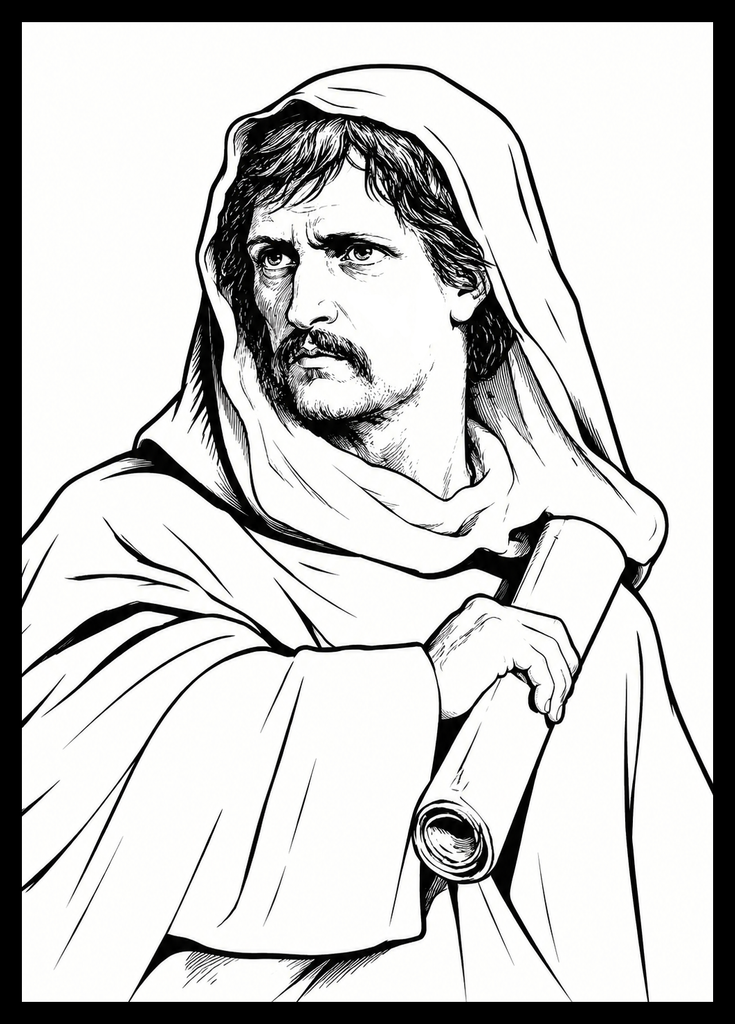
Giordano Bruno, or Iordani Bruni Nolani, as he signed his Latin works, was a brilliant martyr of philosophy and science. A scholar, a philosopher, a practitioner, a poet, and an artist of the imaginal, he believed that every single thing in existence was connected, and that the divine was far larger, more complex, and more intimate than any institution could ever portray. This worldview was a huge part of why he was silenced. It is also why, centuries later, he shines brighter than ever.
Born Filippo Bruno in Nola, a small town near Naples, he spent much of his early life as a Dominican friar. During this phase, he had access to a vast collection of philosophical and theological works, an education that would both form and eventually condemn him. Bruno took a profound liking to Hermes Trismegistus, holding any work attributed to the legendary Egyptian sage in the highest regard. He studied all the Hermetic texts available to him, including works now lost to us, as well as the rich traditions of Neoplatonism and Theurgy. With constant access to what he felt was ancient wisdom speaking directly to him through books, he began to develop his own complex framework for understanding reality and how it could respond to correct alignment, intention, and philosophy.
Bruno spoke highly of the keepers of the tradition who came before him: Agrippa, Albertus Magnus, Iamblichus, Pythagoras, Plato, and Apollonios of Tyana. He felt that Apollonios was the perfect example of a natural magician—what all the ancient philosophers spoke of, but made manifest in a living human vessel. Bruno wrote extensively on Apollonios in several of his surviving works, some of which we will certainly touch on later.
Like a true Renaissance sage, Bruno travelled across Europe, teaching the tradition, collecting ideas, meeting other scholars, and accessing rare documents to study. He was, in essence, the Renaissance version of the wandering philosopher. A man in pursuit of wisdom, unbound by borders or dogma.
Bruno’s brilliance led to intrigue from King Henry III, who was amazed by his extraordinary mastery of mnemonics (advanced memory techniques), granting him royal favor. He was appointed as a professor and royal reader. Bruno was finally recognized, but he wasn’t always respected. His theories and understanding of the cosmos were far ahead of his time and he was often mocked by other scholars for his abstract ideas.
Bruno had a grand plan, he was set on the mission of helping elevate human consciousness and improve the understanding of the experience of reality. He felt he had unlocked ancient knowledge that only a few people in history understood, and wanted to correct the ways of his modern society. He wanted to teach globally, and to write the most clear works of philosophy and science of his day. He wanted to form a bond with the Pope himself, and help influence the ways of society that he felt were the “correct ways” according to the ancients.
However, the last part of his plan was the greatest mistake he would ever convince himself of. When Bruno finally returned to Italy after many years, one thing led to another and his newer, reformed ideas caused word to spread within the inquisition.
Bruno was hunted relentlessly, arrested, and thrown into prison for 8 long years. Eventually, in Rome, he was tried and sentenced to death because he refused to recant his words. He was gagged with a steel spike, tied to a wooden stake, and burned alive. Giordano Bruno was killed for having a mind too brilliant for a controlling force that was working to assume global power and influence at the time.
Bruno’s vision was dangerous not because he denied God, but because he saw God everywhere—too intimately, too democratically. In an age when the Church positioned itself as the sole gatekeeper between humanity and the divine, Bruno argued that every soul was capable of direct communion with the infinite. He believed that magic; understood as the wise alignment of the human will with the living fabric of nature, was a legitimate path to knowledge, one that bypassed scripture, doctrine, and priestly authority. In a world of dogma, he offered experience. In a world of fear, he offered freedom. For this, he had to be removed because he could not be controlled or contained.
His books were confiscated, burned, and placed on the Index Librorum Prohibitorum (Index of forbidden books).The survival of his works like De Magia is proof itself of his theories in practice. Bruno was very clever and knew the inquisition was tightening it’s grip on things. He submitted his books into print presses in multiple different countries to ensure circulation outside of the growing control system. The combination of circumstances ensured their survival, and we are certainly grateful.
The inquisition thought they could cleanse the world of Bruno and that he would be forgotten. Yet here we are, in 2026, still reading his brilliant ideas.
────────────────────